Facebook
 X
X
 Pinterest
 Copy Link
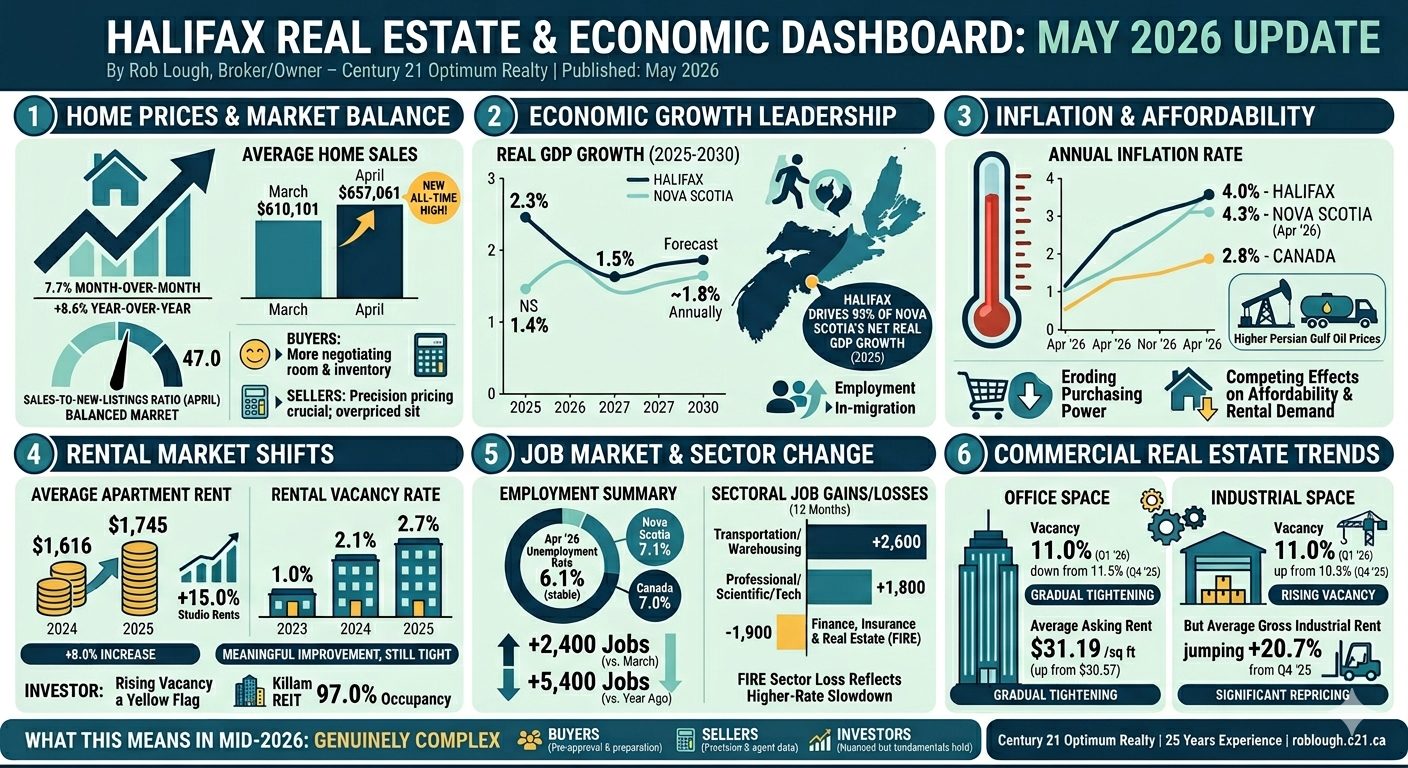
Halifax Real Estate & Economic Dashboard: May 2026 Update
By Rob Lough, Broker/Owner – Century 21 Optimum Realty Published: May 2026 | Halifax-Dartmouth, Nova Scotia
Halifax is not standing still. As of May 2026, the city is posting record home prices, outpacing Canada on GDP growth, and grappling with inflation that is running well ahead of the national average. For buyers, sellers, investors, and renters, the signals are worth understanding, because they point in more than one direction at once.
Here is what the latest data shows.
Home Prices Hit a New All-Time High, But the Market Has Shifted
The average home sale price in Halifax reached $657,061 in April 2026, up from $610,101 in March. That is a 7.7% month-over-month increase and an 8.6% gain year-over-year, a new all-time record for Halifax residential real estate.
And yet, the sales-to-new-listings ratio fell to 47.0 in April, technically placing Halifax in balanced market territory rather than a clear seller’s market.
That combination, record prices alongside a balanced market reading, is unusual, and worth unpacking. Rising inventory is giving buyers more options and more negotiating room, even as the dollar figures at closing keep climbing. The Halifax-Dartmouth Real Estate Market Stats for April 2026 detail exactly how this split is playing out across HRM, including the divergence between average and median prices.
Buyer takeaway: More inventory and a balanced market ratio mean conditions are the most negotiation-friendly they have been in several years. Pre-approval and preparation still matter.
Seller takeaway: Record average prices are real, but they are averages. Overpriced listings are sitting. Accurate pricing from an agent who knows current absorption rates is not optional.
Halifax Is Driving Almost All of Nova Scotia’s Economic Growth
Halifax’s real GDP grew 2.3% in 2025, compared with 1.1% for Canada and 1.4% for Nova Scotia as a whole. The Conference Board of Canada estimates that Halifax accounted for 93% of Nova Scotia’s net real GDP growth in 2025.
Forecasts call for 1.5% real GDP growth in Halifax for 2026, followed by an average of 1.8% annually from 2027 to 2030.
For real estate, this matters because sustained local GDP growth supports employment, in-migration, and household formation, the underlying demand drivers for housing. Halifax is not a market riding a national wave; it is generating its own economic momentum.
Inflation Is Running Hot and That Affects Real Estate Affordability
Halifax’s annual inflation rate hit 4.0% in April 2026, up 1.2 percentage points from March and 2.3 points higher than a year earlier. That compares with national inflation of 2.8% and a Nova Scotia rate of 4.3%.
Higher oil prices linked to conflict in the Persian Gulf have pushed up fuel and transportation costs, which are flowing through to retail prices and the broader cost of living.
For the real estate market, elevated inflation has two competing effects. It can erode purchasing power and tighten affordability for first-time buyers. It can also push rental demand higher as would-be buyers delay purchases, which keeps investment property returns relevant even as prices rise.
Rents Keep Climbing, With Some Early Signs of Easing
Average apartment rent in Halifax rose 8.0%, from $1,616 in 2024 to $1,745 in 2025 across all unit types. Studio apartments saw the sharpest increase, up 15.0% year-over-year.
The rental vacancy rate improved to 2.7% in 2025, up from 2.1% in 2024 and 1.0% in 2023, a meaningful improvement, though conditions remain tight by historical standards.
For a deeper look at what this shift means for landlords and long-term investors, the analysis of Killam Apartment REIT’s Q1 2026 results offers useful institutional context alongside the local picture.
The Halifax rent growth analysis published in March 2026 covers the broader cooling trend and why the affordable end of the rental market remains under significant pressure even as headline vacancy eases.
Investor takeaway: Rising vacancy is a yellow flag worth watching, but 2.7% is still low. Strong rent growth and Killam’s 97.0% occupancy rate both indicate the Halifax rental market continues to generate solid returns for well-positioned investors.
Jobs Are Growing, But Not in Finance and Real Estate
Halifax’s unemployment rate held at 6.1% in April 2026, unchanged from March and below both the national rate (7.0%) and the Nova Scotia rate (7.1%). The city added 2,400 jobs between March and April 2026, and 5,400 jobs compared with a year earlier.
The sector story is mixed. Transportation and warehousing added approximately 2,600 jobs over the past 12 months, and professional, scientific, and technical services added around 1,800. Finance, insurance, and real estate shed approximately 1,900 jobs over the same period — the largest sectoral loss in the city.
For the real estate industry specifically, job losses in the FIRE sector reflect the transactional slowdown from the higher-rate environment that defined 2024 and early 2025. The recovery in sales volume and the return to record prices suggests that the floor may be behind us.
Commercial Real Estate: Office Tightening, Industrial Rents Surging
Office vacancy fell to 11.0% in Q1 2026, down from 11.5% in Q4 2025 and 1.2 percentage points lower than a year ago. Average asking rents for office space reached $31.19 per square foot, up from $30.57 the prior quarter. The gradual tightening of downtown and suburban office space reflects Halifax’s employment and GDP growth translating into real occupier demand.
Industrial vacancy told a different story, rising to 11.0% in Q1 2026, up 0.7 points from Q4 2025. Despite the higher vacancy, average gross industrial rents jumped approximately 20.7% above Q4 2025 levels, a significant repricing that likely reflects lease rollovers and limited quality supply in the most functional industrial nodes.
What This Means If You Are Buying, Selling, or Investing in Halifax Right Now
The Halifax market in mid-2026 is genuinely complex. Record home prices coexist with a balanced market reading. Strong GDP growth runs alongside 4.0% inflation. Rents are rising while vacancy slowly recovers.
A few clear takeaways:
- Buyers have more negotiating room than at any point since 2021, but prices are still high and inflation is eroding purchasing power. Getting pre-approved and working with an agent who can identify value within a rising-average environment is more important than waiting.
- Sellers are still capturing strong prices, but precision matters. The days of listing at any price and attracting multiple offers are behind us in most HRM segments.
- Investors in residential rental property face a more nuanced picture than the 2022–2024 period, but fundamentals, employment growth, in-migration, sub-3% vacancy, remain supportive.
- Commercial tenants and landlords should watch the industrial repricing closely. The gap between rising rents and rising vacancy is unusual and may normalize over the next two quarters.
For a detailed look at how spring 2026 is unfolding in the condo segment specifically, the Halifax-Dartmouth Condo Market Report for April 2026 covers that slice of the market in depth. For a full breakdown of current Halifax market conditions including home prices, rental vacancy, housing starts, and labour data, visit the Halifax Real Estate Market Dashboard.
Related Resources
- Halifax-Dartmouth Real Estate Market Stats: April 2026
- Halifax-Dartmouth Condo Market Report: April 2026
- What Killam’s Q1 2026 Results Tell Us About Halifax’s Rental Market
- Halifax Rent Growth Is Cooling in 2026 — But the Affordable End Remains Squeezed
- Halifax-Dartmouth Real Estate Market Stats: March 2026
Rob Lough is Broker/Owner at Century 21 Optimum Realty, serving Halifax Regional Municipality, East Hants, and the Truro/District 104 corridor. With 25 years of Nova Scotia real estate experience, including time as a certified Home Inspector, Rob brings a practical, data-grounded perspective to buyers, sellers, and investors across the region. Connect at roblough.c21.ca.