Facebook
 X
X
 Pinterest
 Copy Link
Nova Scotians Say Housing Is Unaffordable. New NSAR Research Tells Us Why and What They Want Done About It.
By Rob Lough, Broker/Owner | Century 21 Optimum Realty | Halifax-Dartmouth, Nova Scotia Published: April 2026
A new survey commissioned by the Nova Scotia Association of REALTORS (NSAR) and conducted by Abacus Data has put hard numbers to something many Nova Scotians already feel in their bones: the housing situation in this province is broken, and almost everyone knows it.
The findings are striking not because they’re surprising, but because they’re so consistent across age groups, income levels, and housing situations. This isn’t fringe sentiment. It’s consensus.
87% Are Concerned. That’s Not a Statistic — That’s Nearly Everyone.
87% Are Concerned. That’s Not a Statistic — That’s Nearly Everyone.
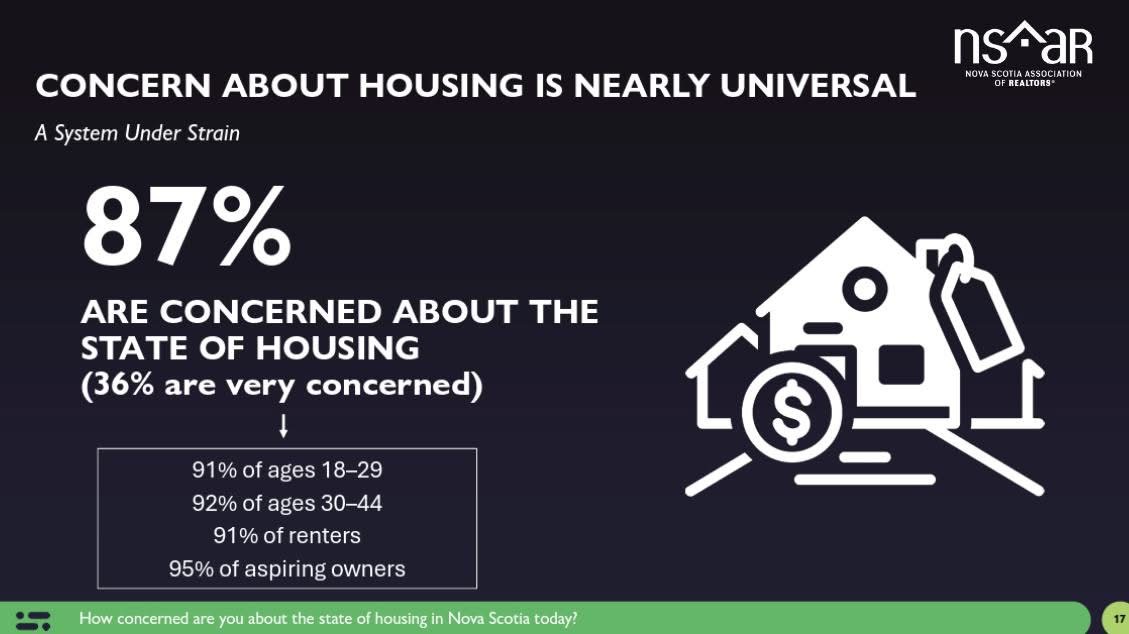
The headline figure from the NSAR/Abacus research is that 87% of Nova Scotians are concerned about the state of housing in the province. More than a third of those, 36%, say they are very concerned.
That concern is not evenly distributed, but it’s close. Among adults aged 18 to 29, 91% express concern. Among those aged 30 to 44, the figure rises to 92%. Among renters, 91% are concerned. Among aspiring homeowners, the number climbs to 95%.
Put differently: if you’re working with a first-time buyer, a renter trying to move toward ownership, or a young family trying to plan their next step, you are almost certainly talking to someone who views housing as a serious problem in their community. That framing matters for every conversation you have in this market.
77% Say Housing Is Unaffordable Right Now
77% Say Housing Is Unaffordable Right Now
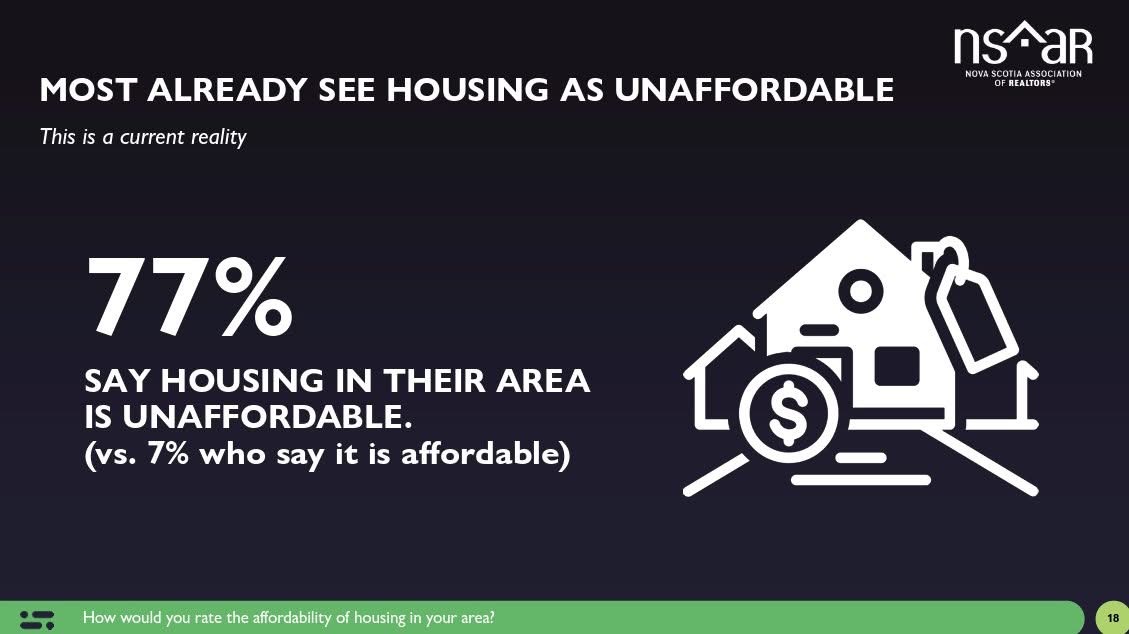
Beyond concern about the future, the survey asked Nova Scotians how they rate housing affordability today. Seventy-seven percent said housing in their area is unaffordable. Only 7% said it is affordable.
That gap is not a rounding error. It reflects a lived reality that recent Halifax-Dartmouth market data confirms: average prices in HRM have held in the high five hundreds to low six hundreds through the past year, while closing costs, land transfer taxes, and tighter mortgage qualification rules add thousands more to what buyers need to bring to the table before they can get a key in their hand.
For buyers feeling that pressure, understanding the full picture of what entry into this market actually costs is the starting point. A home listed at $500,000 in Halifax carries an HRM deed transfer tax of $7,500 alone, before legal fees, home inspection, title insurance, or prepaid property taxes. Budget roughly 2.5 to 3% of the purchase price beyond the down payment to cover all closing costs.
The Dream Hasn’t Died – But It’s Under Strain
73% of non-homeowners in Nova Scotia still want to own a home someday.
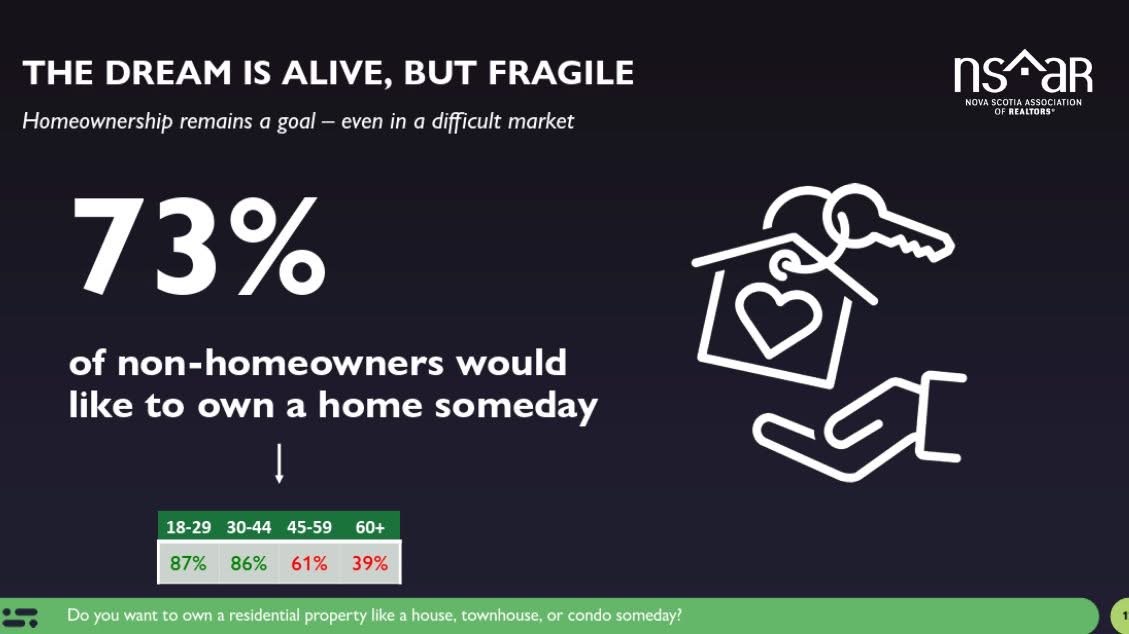
One of the most human findings in the NSAR data is this: 73% of non-homeowners in Nova Scotia still want to own a home someday.
That figure is not uniform across age. Among adults 18 to 29, the desire to own is at 87%. Among those 30 to 44, it’s 86%. It drops to 61% for the 45 to 59 cohort, and to 39% for those 60 and older, which reflects a combination of changing life circumstances and, likely, some degree of recalibrated expectation.
The aspiration to own remains deeply embedded in how most Nova Scotians think about their future. What’s changed is their confidence in getting there. The dream is alive, but the path feels longer than it used to.
For clients navigating that gap between wanting to buy and feeling like they can, tools matter. The Nova Scotia 2% Down Payment Assistance Program has meaningfully reduced the upfront cash barrier for qualifying buyers. Understanding your GDS and TDS ratios before you start shopping tells you your real budget, not an optimistic estimate of it.
What Nova Scotians Want Done About It
Perhaps the most policy-relevant section of the NSAR/Abacus research is what Nova Scotians believe will actually improve affordability. Three broad solution categories were tested, and the top responses within each are instructive:
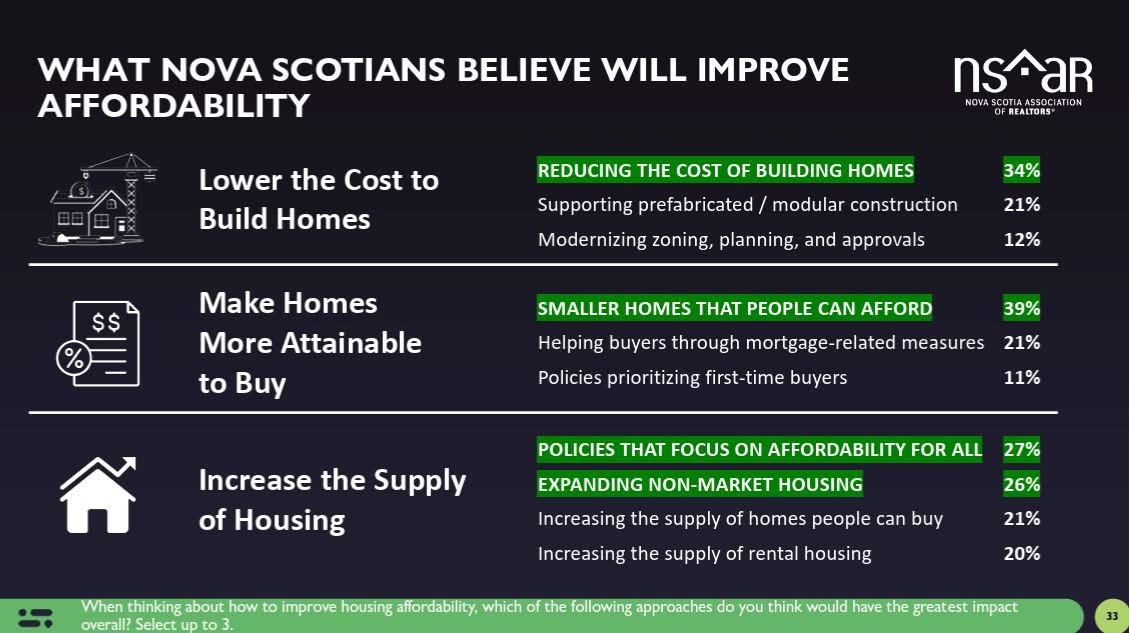
Lower the cost to build homes. Thirty-four percent identified reducing construction costs as the most impactful measure. Prefabricated and modular construction drew 21% support, and zoning modernization drew 12%.
Make homes more attainable to buy. Thirty-nine percent, the single highest response in the entire survey, said smaller homes that people can actually afford are the most important answer. Mortgage-related support measures drew 21%, and policies prioritizing first-time buyers drew 11%.
Increase supply. Policies focused on affordability for all drew 27% support, expanding non-market housing drew 26%, increasing the supply of homes people can buy drew 21%, and growing rental supply drew 20%.
The fact that “smaller homes people can afford” topped every other option by a significant margin is worth sitting with. Nova Scotians are not asking for more subsidies or more complex government programs as their primary solution. They’re asking for a product that exists at a price they can actually reach.
That’s a market signal as much as a policy one. Developers, municipalities, and lenders who respond to it will be working with the grain of what buyers actually want. Those who don’t will keep building product that sits out of reach for the majority of the population.
What This Means for Buyers and Sellers in HRM and Central Nova Scotia
For buyers: You are not alone in finding this market hard. The data says so. But the data also says the tools that work, understanding your mortgage pre-approval, knowing your true closing cost budget, using available assistance programs, and working with current market conditions rather than waiting for a perfect entry point, are still the most reliable path forward. Markets in Truro and Bible Hill continue to offer meaningfully better price-per-square-foot value than HRM for buyers who have flexibility on location.
For sellers: Seventy-three percent of renters and non-owners want to become homeowners. That is your buyer pool. It’s motivated, it’s real, and it’s looking for homes priced and positioned to reflect current affordability thresholds. Aspirational pricing in this environment works against you. Accurate pricing, combined with strong presentation, continues to produce results.
The NSAR research doesn’t just confirm what the market feels like, it quantifies it. And it gives every party in a transaction, buyer, seller, builder, and government, a clearer picture of what needs to change. For the full picture on what the April market data is showing, the April 2026 Halifax-Dartmouth market stats break it all down: April 2026 Real Estate Statistics
By Rob Lough, Broker/Owner, Century 21 Optimum Realty. Serving Halifax Regional Municipality, East Hants, and the Truro/District 104 corridor. Over 25 years of Nova Scotia real estate experience, including a background as a licensed Home Inspector.
Related Resources
- Closing Costs When Buying in Nova Scotia
- Halifax-Dartmouth Real Estate Market Stats — February 2026
- What’s a Good Mortgage Rate in Nova Scotia — March 2026
- Spring 2026 in Halifax — Buyer and Seller Guide
- Truro/Bible Hill Real Estate Market Stats — March 2026
- Halifax/Dartmouth Real Estate Market Stats – April 2026