Facebook
 X
X
 Pinterest
 Copy Link
Canadian Housing Markets Aren’t Moving in Sync – Here’s What That Means for Halifax Buyers and Sellers
By Rob Lough, Broker/Owner | Century 21 Optimum Realty | Halifax-Dartmouth, Nova Scotia Published: April 2026
If you’ve been reading national real estate headlines lately, you may have noticed they don’t quite match what you’re seeing in your own neighbourhood. That’s not a mistake, it’s actually the story right now.
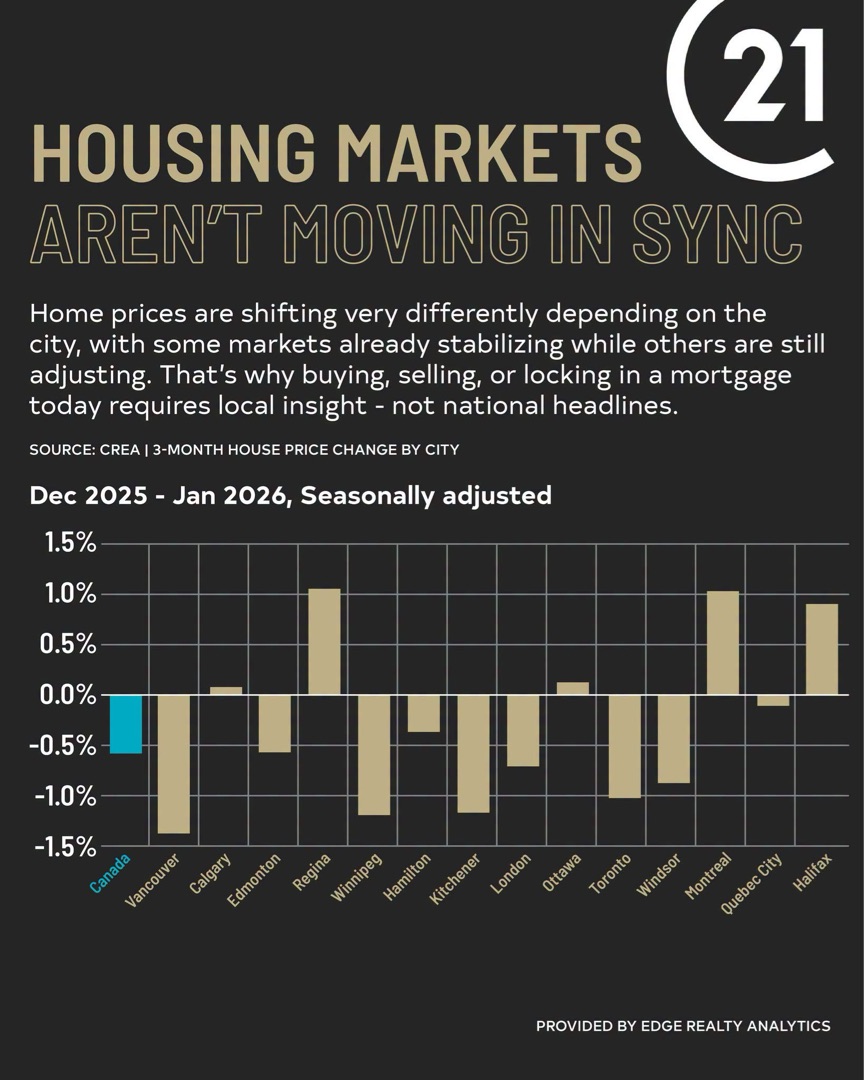
A new CREA chart showing three-month seasonally adjusted price changes by city tells it plainly: Canadian housing markets are not moving in sync. Some cities are posting gains. Others are still correcting. And a few are sitting right on the zero line, holding their breath.
The national average is essentially flat – down about half a percent over three months. But averages hide the real picture.
What the City-by-City Data Actually Shows
The December 2025 to February 2026 CREA data reveals a market that’s fracturing along local fault lines:
Canadian Housing Markets Aren’t Moving in Sync – Here’s What That Means for Halifax Buyers and Sellers
Positive territory: Regina, Montreal, and Halifax are among the cities showing modest price gains over the three-month period. Halifax’s bar sits just above zero, a quiet signal that demand here is holding.
Negative territory: Vancouver, Winnipeg, Hamilton, Kitchener, Windsor, and parts of Ontario are still giving back gains. Some markets are down more than 1% over just three months, meaningful movement in a short window.
What’s driving the split? A few forces are at work:
- Local employment and population growth. Markets attracting inter-provincial migrants and new jobs are absorbing supply faster. Nova Scotia and parts of Atlantic Canada have benefited from buyers priced out of larger centres.
- How far prices ran up in 2020-2022. Markets that overshot the most, many in Ontario and B.C., are still correcting. Regions that rose modestly have less to give back.
- Inventory. Where new listings are piling up, buyers have leverage. Where supply is constrained, even higher rates haven’t created a true buyer’s market.
- Rate sensitivity. Highly leveraged, investor-heavy markets feel every Bank of Canada move more acutely than owner-occupied markets with longer-term holders.
Halifax Is a Different Story
While Ontario markets continue to work through their correction, Halifax is on a different part of the curve.
The Halifax-Dartmouth Real Estate Market Stats for March 2026 show 330 homes sold, up sharply from the January low of 223, with total sales volume recovering to $205.9 million. New listings are returning in line with seasonal norms, and active inventory, while up year-over-year, remains modest at 978 homes across the entire HRM.
That’s not the profile of a market in distress. It’s the profile of a market rebalancing.
Days on market have lengthened compared to the frenzy of 2021-2023, which is healthy. Buyers have time to do due diligence. Sold-to-ask ratios are below 100%, which means negotiating room exists that didn’t a year ago. But sellers who price accurately are still walking away close to their ask.
Same Province, Different Story And Why It Matters
Even within Nova Scotia, local context matters enormously.
The Truro-Bible Hill market stats for March 2026 show a tighter, more affordable market with its own seasonal rhythms, different from urban HRM in pace and buyer profile. What works as a pricing strategy in Clayton Park may not work in Bible Hill, and vice versa.
This is why the national headline, “prices down in Canada”, is nearly useless as a decision-making tool.
What This Means for You
🏠 If you’re buying in Halifax:
Don’t wait for a headline-driven price crash that may not apply here. In markets with limited inventory and rising spring activity, waiting can mean paying more by June than you would today.
Get hyper-local comps, ideally the last 30-60 days, not last year’s averages. The spring 2026 Halifax market guide has more on what to expect heading into the active season.
🏠 If you’re selling in Halifax:
Pricing ahead of the trend rather than chasing it down matters now more than ever. In the current environment, overpriced listings sit and every extra week on market erodes buyer confidence. Strong presentation, accurate pricing, and experienced marketing still produce results.
The Halifax condo market through March 2026 shows buyers have more choice than a year ago, which means competition at the listing level is real. Getting the strategy right from day one isn’t optional.
🏠 If you’re renewing or refinancing:
Local price trends matter for decisions like refinancing, consolidating, or adding a rental unit to offset higher carrying costs. For context on the rental side of the equation, see how Halifax rent growth is shifting in 2026, demand for rentals remains firm at the affordable end even as the broader market cools.
How to Read the Chart
Each bar in the CREA graphic shows the seasonally adjusted price change over three months in that city. Positive bars indicate a market that’s at least holding its ground or gaining. Deeper negative bars point to markets where buyers have meaningful negotiating power right now.
Halifax’s bar is positive. That’s the number that matters most for buyers and sellers in our market.
The Bottom Line
National real estate data is a starting point, not a strategy. The right move in Calgary may be the wrong move in Kitchener. And the right move in Halifax is informed by Halifax data, not a national average that blends 14 very different city stories into one number.
Thinking of making a move this spring? A Century 21 Optimum Realty agent can show you exactly where your neighbourhood sits on the curve – whether prices are still resetting, have stabilized, or are starting to climb again, so you can choose the timing and strategy that fit your goals.
Contact Rob Lough at roblough.c21.ca for a no-obligation conversation about your next move.
Related Resources
- Halifax-Dartmouth Real Estate Market Stats – March 2026
- Truro-Bible Hill Real Estate Market Stats – March 2026
- Halifax Condo Apartment Market Report – March 2026
- Spring 2026 in Halifax – Market Guide
- Halifax Rent Growth Is Cooling in 2026
Rob Lough is Broker/Owner at Century 21 Optimum Realty, serving Halifax Regional Municipality, East Hants, and the Truro/District 104 corridor. With 25+ years of Nova Scotia real estate experience, including five years as a licensed Home Inspector, Rob brings practical market knowledge to every transaction.