Facebook
 X
X
 Pinterest
 Copy Link
Halifax Housing Starts vs. Reality on the Ground: What the Numbers Mean for Buyers and Sellers
By Rob Lough, Broker/Owner — Century 21 Optimum Realty
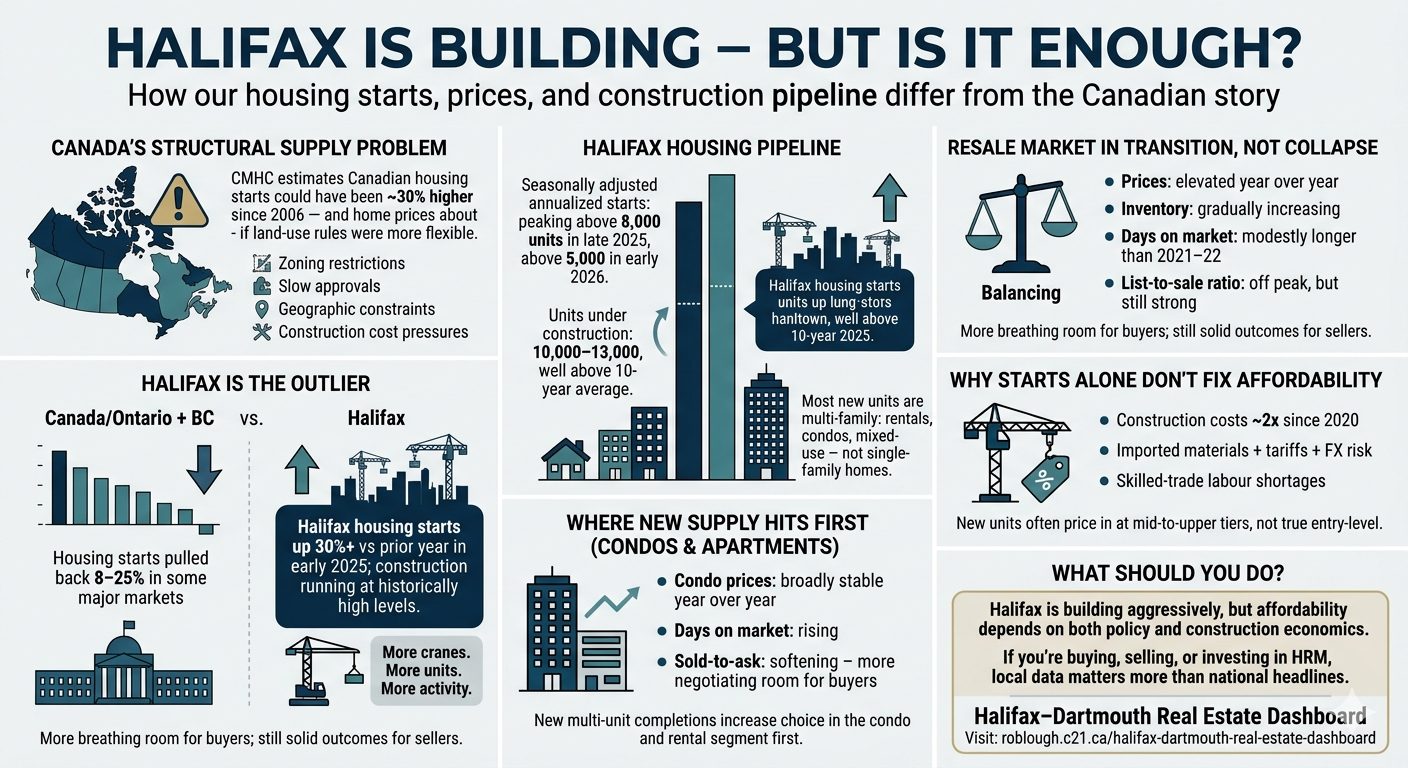
Canada’s housing supply problem has a name now, and a number attached to it. CMHC research suggests that if Canadian land-use rules had allowed the same market responsiveness as the United States, housing starts could have been up to roughly 30% higher since 2006 and home prices about 10% lower. Zoning restrictions, slow approval timelines, geographic constraints, and structural cost pressures have quietly compounded over two decades into a supply gap that still hasn’t closed.
For a deeper dive into how these national trends intersect with Halifax’s current numbers, see my latest Halifax-Dartmouth Real Estate Market Stats update.
But Halifax isn’t Ontario. On my Halifax-Dartmouth real estate hub, I track local conditions every month, and the picture here is meaningfully different from the national headline. More cranes, more units, more activity, and a resale market that’s adjusting in real time. Here’s what the numbers actually mean if you’re buying, selling, or investing in HRM right now.
What CMHC Says About Regulation and Housing Starts
CMHC’s position, backed by research from firms like ConnectCRE, is that Canada’s land-use framework has made our housing supply structurally less responsive to demand than in comparable markets. When demand rises sharply, as it did during the pandemic migration boom, the supply side can’t keep up because entitlement timelines are long, zoning is restrictive, and builder margins get squeezed before projects even reach permit.
The national picture bears this out. Starts in British Columbia and Ontario have pulled back 8 to 25% in recent periods. Some major markets that should be building aggressively are actually producing fewer units than population growth demands. Nationally, starts have been flat to modestly positive in larger centres, but not at a pace that closes the structural gap CMHC has identified.
Halifax is the exception, and that distinction matters for how you interpret what’s happening on the ground here.
Halifax Housing Starts: Building Like Crazy, But Is It Enough?
Halifax has been doing exactly what federal housing policy has been asking of Canadian cities: ramping up construction, prioritizing density, and cutting red tape where possible. If you want to see how that construction shows up in prices, sales, and inventory, my Halifax-Dartmouth market dashboard tracks it month by month.
The numbers back it up. Halifax housing starts were up more than 30% in the early months of 2025 compared to the prior year, far ahead of national growth rates in the mid-single digits. Seasonally adjusted annualized figures hit above 8,000 units at points in late 2025 and came in above 5,000 in early 2026. Total units under construction in HRM have been running between 10,000 and 13,000, well above the 10-year historical average.
The composition of that pipeline matters too. The large majority of these units are multi-family: purpose-built rental, mid-rise condo, and mixed-use projects. This aligns with both provincial affordability goals and where developer economics currently make sense. It also means the segment of the market most likely to feel the impact of extra supply first is apartments and condos, not single-family detached.
So on paper, Halifax is doing the right things. The question is whether that translates into tangible relief for buyers and renters, and the resale data gives us a more nuanced answer.
What the Resale Market Is Actually Doing
New construction and resale don’t move in lockstep. While Halifax’s building pipeline is exceptional, the existing-home market has been absorbing its own set of pressures: tighter inventory, elevated prices, and a buyer pool that expanded sharply with in-migration and is now adjusting to higher carrying costs.
For a full breakdown of the latest numbers, see my Halifax-Dartmouth Real Estate Market Stats: May 2026 report. The short version: prices remain elevated year over year, inventory has been inching upward, and the market is beginning to show signs of normalization without tipping into a buyer’s market. Days on market have stretched modestly, and list-to-sale ratios have edged down from the peaks of 2021 to 2022, but we’re not seeing distress.
This is a market in transition, not collapse. Sellers are still generally achieving strong prices. Buyers are getting slightly more breathing room than they had two years ago. Neither side should be making decisions based on the extreme conditions of the pandemic cycle.
The Condo and Apartment Story: Where New Supply Shows Up First
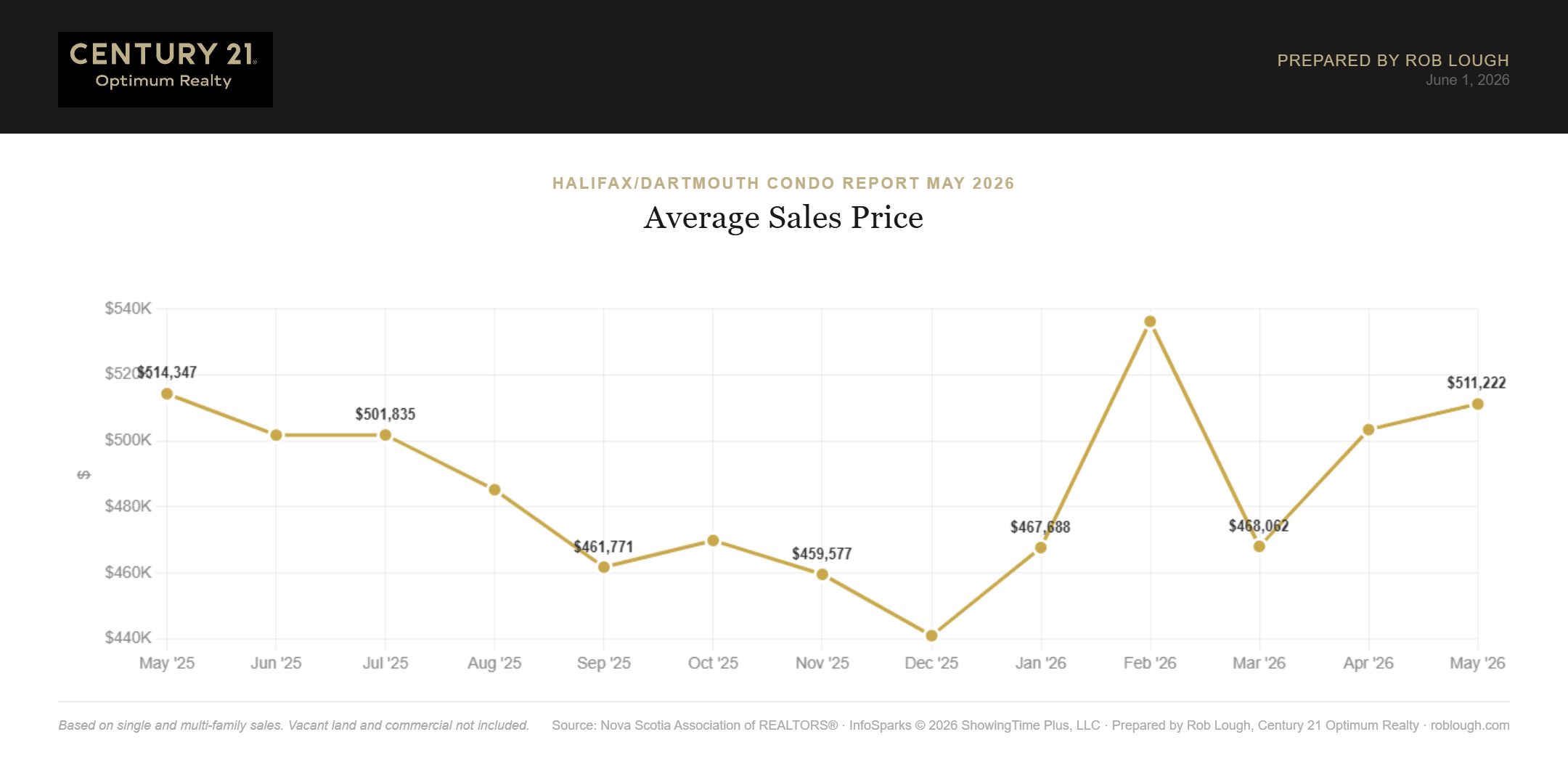
Halifax-Dartmouth Condo Market Report May 2026 average sales price
If you want to see where Halifax’s construction boom is starting to register in real pricing, condos and purpose-built apartments are the place to look.
My Halifax-Dartmouth Condo Market Report: May 2026 tracks this segment monthly. Average condo prices have held firm year over year, but days on market have increased and the sold-to-ask ratio has softened slightly, meaning buyers in this segment are beginning to see modest negotiating room that wasn’t available a year ago.
This makes intuitive sense. The bulk of Halifax’s under-construction pipeline is multi-unit, and as new product delivers, buyers in the condo and rental space gain alternatives they didn’t have before. That added choice tends to take pressure off resale pricing and shift negotiating dynamics incrementally in favour of purchasers. We’re not at a point of oversupply, not even close, but the directionality is moving toward greater balance.
For investors and first-time buyers evaluating pre-construction versus resale in this environment, the condo segment deserves close attention. If you’re specifically interested in new-build and pre-construction opportunities in Halifax-Dartmouth, I maintain a curated list of current and upcoming projects here. The latest monthly Halifax-Dartmouth condo updates will be your best real-time read on where that’s heading.
Why Starts Alone Don’t Solve Affordability
Here’s the part of the story that doesn’t fit neatly on a campaign poster: even with Halifax building at a historically elevated pace, new supply alone can’t resolve an affordability challenge that’s also driven by cost-of-construction economics.
Building costs in Canada have roughly doubled since 2020. At the same time, recent mortgage rule changes have reshaped how first-time buyers and move-up buyers qualify and structure their financing, especially for new-build purchases. A significant portion of materials, lumber, windows, mechanical components, is imported, and exchange rates and tariff exposure have made input costs volatile. Labour shortages in the trades have pushed timelines out and wage costs up. The result is that developers need to price new units at levels that recover those costs, which means much of the new supply entering the Halifax market is positioned at the middle-to-upper end of the price spectrum rather than at entry-level affordability.
This is the gap that CMHC’s research points to but that zoning reform alone can’t close. You can approve more units, streamline permits, and increase density allowances, and Halifax has made real progress on all of those, but if the economics of construction keep new unit pricing out of reach for median-income buyers, the supply increase doesn’t translate directly into affordability relief at the lower end of the market.
For buyers: More selection is coming, and negotiating conditions are slowly improving. But waiting for a significant price correction driven by supply alone is likely not the right strategy, particularly given continued in-migration and population growth projections for HRM.
For sellers: Pricing strategy matters more than it did in 2021. With more new product competing for buyer attention, overpriced listings are sitting longer. The days of accepting any offer in 72 hours without preparation are largely behind us in most segments.
You can find my latest Halifax-Dartmouth market updates, condo reports, and buyer/seller guides on my main market stats hub.
What Should You Do With This Information?
The national housing supply story and Halifax’s local construction boom are both real, and they point in different directions depending on who you are and what you’re trying to accomplish.
If you own property in Halifax-Dartmouth and want to understand how this construction wave and the May 2026 numbers affect your specific situation, whether that’s timing a sale, refinancing, deciding to hold a rental property, or evaluating a purchase, I’d encourage you to reach out directly. You can find my contact information on my home page, and I’m happy to walk through what the data means for your particular circumstances.
The market is nuanced right now. That’s exactly when local expertise matters most. If new construction is part of your plan, start by browsing current new-build and pre-construction opportunities. For a full breakdown of current Halifax market conditions including home prices, rental vacancy, housing starts, and labour data, visit the Halifax Real Estate Market Dashboard.
Rob Lough is the Broker/Owner of Century 21 Optimum Realty in Halifax-Dartmouth, Nova Scotia, with 25 years of experience in the Nova Scotia real estate market.
Related Resources:
- Halifax-Dartmouth Real Estate Market Stats: May 2026
- Halifax-Dartmouth Condo Market Report: May 2026
- Halifax-Dartmouth Real Estate Market Dashboard
Next steps for buyers and sellers
If you’re exploring brand-new construction, you can review current and upcoming new-build opportunities at my Halifax-Dartmouth new-construction hub. For a broader look at pricing, sales volume, and inventory trends, keep an eye on my Halifax-Dartmouth Real Estate Market Stats and Condo Market Reports, which I update monthly.