Facebook
 X
X
 Pinterest
 Copy Link
Average Age of First-Time Home Buyers in Canada and What the Data Means for Nova Scotia
By Rob Lough, Broker/Owner | Century 21 Optimum Realty | Halifax-Dartmouth, Nova Scotia Published: March 2026
The Question More Buyers Are Asking
If you’re in your late 20s or early 30s and still renting, you’re not behind. You’re exactly in line with where most first-time buyers across Canada find themselves right now. But the data also tells a more complicated story, one that’s worth understanding if you’re planning your path to ownership in Nova Scotia.
The National Picture: Mid-30s on Average
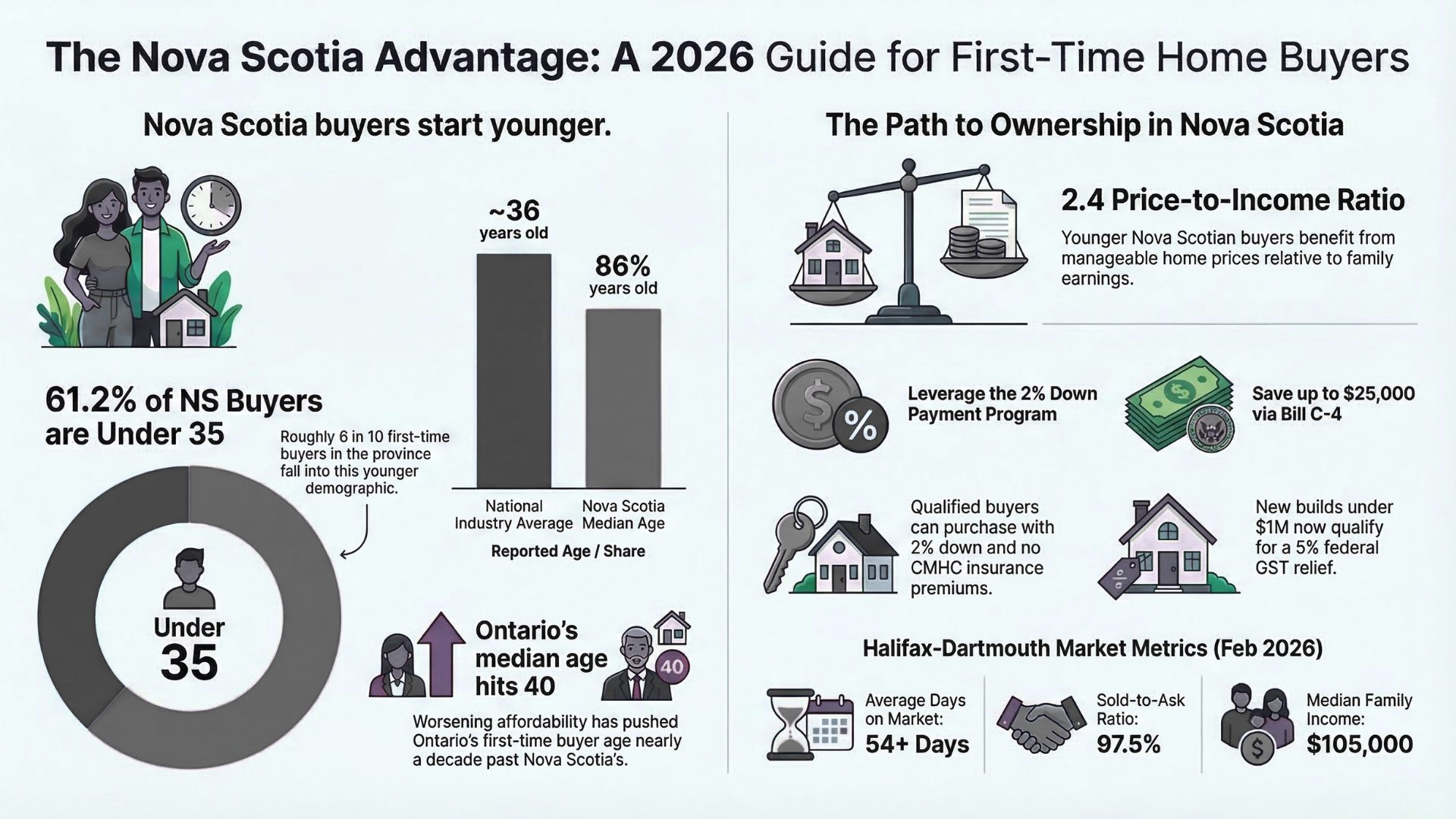
The most commonly cited figure for the average Canadian first-time home buyer puts them at around 36 years old. That number shows up consistently across industry analyses drawing on national sales data.
Statistics Canada tax data tells a slightly different story. Looking at Canadians who claimed the federal First-Time Home Buyers’ Amount on their tax returns, the median age in 2022 was 32, up from approximately 30 a decade earlier. The median and average diverge because a growing share of older buyers is pulling the average upward.
CMHC’s mortgage consumer survey data adds further texture: nearly half of recent first-time buyers — 47% — fall between the ages of 25 and 34, but the share over 35 has been increasing year over year.
| Measure / Source | Reported Age |
|---|---|
| Industry “average” (Canada-wide) | ~36 years old |
| Median, tax filers (national, 2022) | 32 years old |
| Main age band (CMHC surveys) | 47% between 25–34 |
| Ontario median (Teranet, 2024) | ~40 years old |
The Age Is Creeping Up and Affordability Is Why
This isn’t a coincidence. The upward drift in first-time buyer age tracks closely with worsening affordability across Canada. Longer saving periods, rising home prices, higher stress-test thresholds, and the sheer cost of a down payment in competitive markets have all pushed the milestone later. That difficulty is confirmed by new NSAR province-wide research 87% of Nova Scotians are concerned about housing, and only 7% say it’s affordable in their area.
Nowhere is this more visible than in Ontario, where Teranet data from 2024 puts the median first-time buyer age at close to 40, a full decade ahead of where the national median sat in the early 2010s.
Nova Scotia Looks Different, But In a Good Way
Atlantic Canada, and Nova Scotia in particular, tells a more accessible story.
In 2020, 61.2% of Nova Scotia first-time buyers were under 35 years old, meaning roughly 6 in 10 first-time buyers here are still in that core younger demographic. Another 34.1% were between 35 and 54, with very few at 55 or above.
Statistics Canada’s analysis of federal Home Buyers’ Amount claimants found that Nova Scotia first-time buyers had a median age of 31 in 2018, the same as Ontario at that time, and lower than British Columbia at 33. By the 2022 national snapshot, the median had moved to 32 across Canada, and Nova Scotia likely tracks close to that figure.
The short version: the typical first-time buyer in Nova Scotia is around 31–32 years old, younger than the national average and considerably younger than Ontario’s current median.
| Measure / Region | Figure |
|---|---|
| NS share of first-time buyers under 35 (2020) | 61.2% |
| NS first-time buyer median age (2018) | 31 years |
| National median age (First-Time HBA, 2022) | 32 years |
| NS median family income, first-time under 35 (2020) | $105,000 |
| NS price-to-income ratio, under 35 (2020) | 2.4 |
Income and Affordability Context
The 2020 Nova Scotia data also captures something encouraging about local affordability relative to income. First-time buyers under 35 and those between 35 and 54 both reported a median family income of $105,000, meaning income levels between the two groups were essentially identical.
Where the difference shows up is in the price-to-income ratio. Buyers under 35 carried a ratio of 2.4, compared to 2.6 for the 35–54 group and 2.1 for buyers 55 and older. Younger buyers are paying a slightly higher multiple of their income for the same homes, a modest premium, but one that reflects the tighter savings position most under-35 buyers are in when they enter the market.
It’s also worth noting that Nova Scotia recorded a declining share of under-35 first-time buyers between 2018 and 2020, consistent with the affordability pressures building across the province during that period. The trend likely continued through the pandemic-era price surge.
What This Means If You’re Buying in Halifax-Dartmouth Right Now
For buyers in their late 20s or early 30s: You’re arriving at the right time in Halifax’s cycle. The February 2026 market data shows 54+ days average on market and a 97.5% sold-to-ask ratio — the most favourable buying conditions since before the pandemic. More time, more inventory, and more room to negotiate than at any point in the past three years.
For buyers who have waited longer than they expected: You’re not alone, and you’re not too late. The over-35 cohort represents a substantial and growing share of first-time purchases nationwide. If extended saving has improved your down payment position, that can translate directly into better mortgage terms and lower carrying costs going forward.
Before you start your search in earnest, getting mortgage pre-approved should be your first step. It clarifies your budget, locks in a rate, and signals to sellers that you’re a serious, qualified buyer. It’s also worth understanding your GDS and TDS ratios before you walk into a lender conversation — those numbers are the gatekeepers to your mortgage approval.
Programs That Can Help Nova Scotia First-Time Buyers
The affordability picture is real, but so are the tools available to address it. Two programs worth understanding in detail:
Nova Scotia’s 2% Down Payment Program allows qualified buyers to purchase with just 2% down instead of the standard 5%, with the Province backing the mortgage guarantee and significantly no CMHC insurance premium. The full details are covered in this guide to Nova Scotia’s 2% down program.
Bill C-4 GST Relief for New Homes received Royal Assent on March 12, 2026, removing the 5% federal GST on qualifying new construction homes priced up to $1,000,000 for eligible first-time buyers. For a $500,000 new build, that’s up to $25,000 back in your pocket. Everything you need to know is in the Bill C-4 breakdown for Nova Scotia buyers.
It’s also worth knowing that if you’ve been through a separation or divorce, you may re-qualify as a first-time buyer under the federal definition, even if you previously owned a home with a former partner.
The Bottom Line
The average first-time buyer in Canada is around 36. The median, based on tax data, sits at 32 nationally and 31 in Nova Scotia. Both numbers have been drifting upward, and that trend is unlikely to reverse quickly without meaningful changes to supply and affordability.
But Nova Scotia, and Halifax specifically, remains one of the more accessible entry points into Canadian homeownership. The price-to-income ratios here are still manageable compared to Ontario and British Columbia. The programs exist. And the current market window, as outlined in the Spring 2026 Halifax buyer and seller guide, is among the most favourable for first-time buyers in recent memory.
Whether you’re 28 or 42, the right time to buy is when your finances, your life circumstances, and the market align. If you want to understand what that looks like for your specific situation in Halifax Regional Municipality, East Hants, or the Truro market, I’m here to walk you through it.
📞 Contact Rob Lough — Century 21 Optimum Realty
Related Resources
- Why Getting Pre-Approved Is the Smartest First Step When Buying a Home in Halifax
- GDS vs. TDS Ratios: Your Complete Guide to Canadian Mortgage Qualification
- Nova Scotia’s 2% Down Payment Program: What First-Time Buyers Need to Know
- Bill C-4 GST Relief for First-Time Buyers in Nova Scotia
- Halifax-Dartmouth Real Estate Market Stats — February 2026
- Spring 2026 in Halifax: What Buyers and Sellers Need to Know