Facebook
 X
X
 Pinterest
 Copy Link
How to Price Your Home to Sell in Halifax Spring Market 2026: Why the First Week on Market Matters Most
By Rob Lough, Broker/Owner – Century 21 Optimum Realty | Halifax-Dartmouth, Nova Scotia
If you’re thinking about selling your home in Halifax-Dartmouth or anywhere in Nova Scotia, there’s one decision that will shape your entire selling experience more than any other: your asking price.
Price it right from day one and you could sell quickly—often for at or above asking. Overprice it, even slightly, and the data shows your negotiating power drops with every passing week. Let’s look at what the numbers actually say about pricing strategy in today’s Nova Scotia market.
The Data Doesn’t Lie: Days on Market Erode Your Sale Price
One of the most important metrics in real estate is the relationship between Days on Market (DOM) and the Sale-to-Asking Price ratio (S/A%). In simple terms, the longer your home sits unsold, the less money you’re likely to get for it.
Current market data for Halifax-Dartmouth tells a clear story:
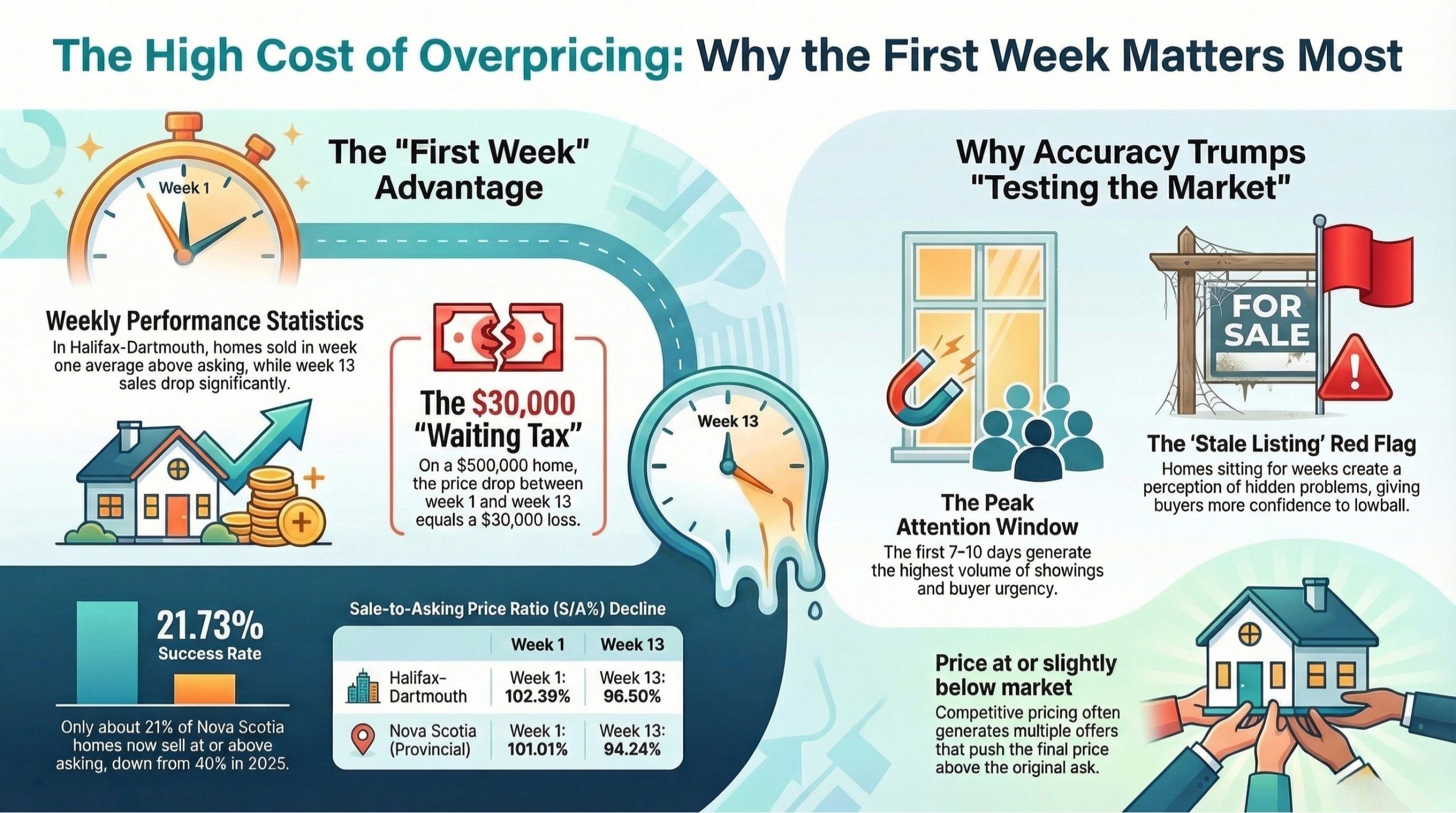
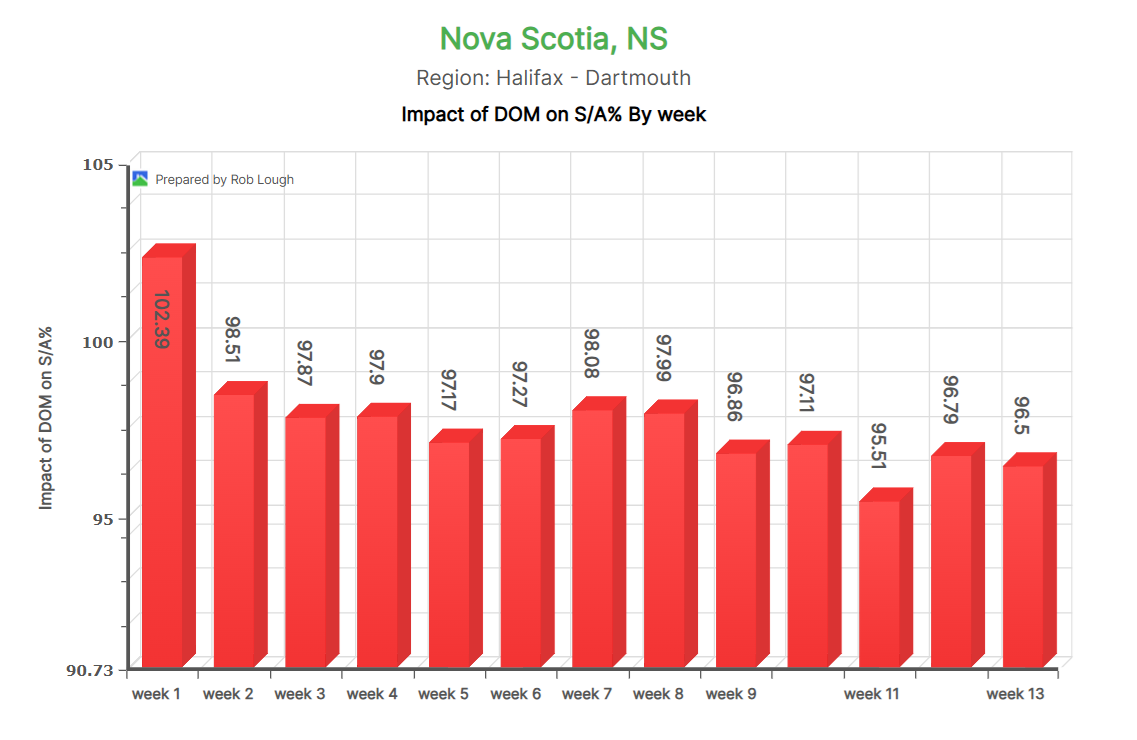
Homes that sell in their first week on the market achieve an average of 102.39% of asking price—meaning buyers are actually paying above list price to secure those properties. But by week 13, that number drops to just 96.50% of asking price.
How to Price Your Home to Sell in Halifax: Why the First Week on Market Matters Most
That’s a swing of nearly 6 percentage points. On a $500,000 home, that’s roughly a $30,000 difference in your pocket—simply because of how long the property sat on the market.
The Same Pattern Holds Across Nova Scotia
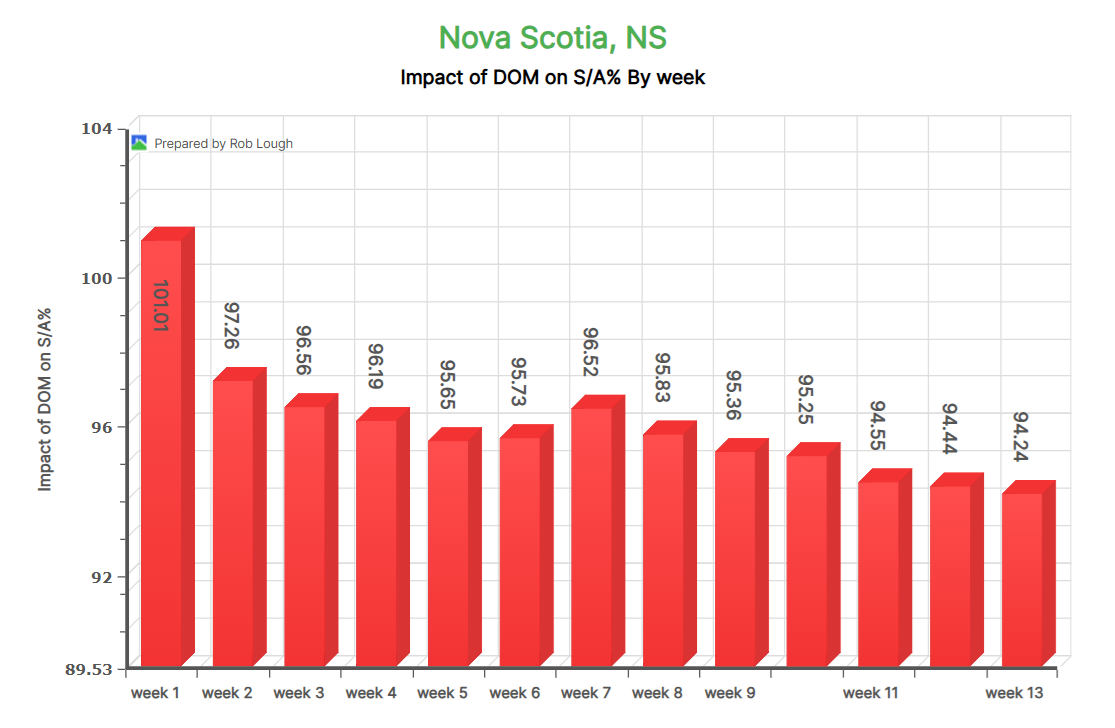
This isn’t just a Halifax phenomenon. Looking at the province-wide data for Nova Scotia, the pattern is just as striking:
Homes selling in week 1 achieve an average S/A% of 101.01%—still above asking. By week 13, that figure falls to 94.24%. That’s a nearly 7% decline in sale price relative to asking—an even steeper drop than in HRM alone.
How to Price Your Home to Sell in Nova Scotia: Why the First Week on Market Matters Most
The takeaway is straightforward: across every region of the province, the longer your home lingers on the market, the more leverage shifts to the buyer.
Why Overpricing Your Home Backfires
Many sellers assume they can always “test the market” with a higher price and reduce later if it doesn’t sell. It sounds logical, but in practice it’s one of the most costly mistakes a homeowner can make. Here’s why:
You miss the peak buyer attention window. The first 7–10 days on market generate the most showings, interest, and urgency. Buyers and their agents are watching for new listings. If your price is out of range, those serious buyers move on—and they rarely come back.
Stale listings raise red flags. When a home sits on the market for weeks, buyers start to wonder what’s wrong with it. Even if the answer is simply “it was overpriced,” the perception of a problem has already taken hold. This gives buyers confidence to submit lower offers.
Price reductions signal desperation. A price drop tells buyers you’ve already lost the negotiation. Many will wait to see if there’s another reduction—or submit an offer well below the new asking, knowing you’ve already shown flexibility.
Fewer Homes Are Selling at Full Price—Here’s What That Means for Sellers
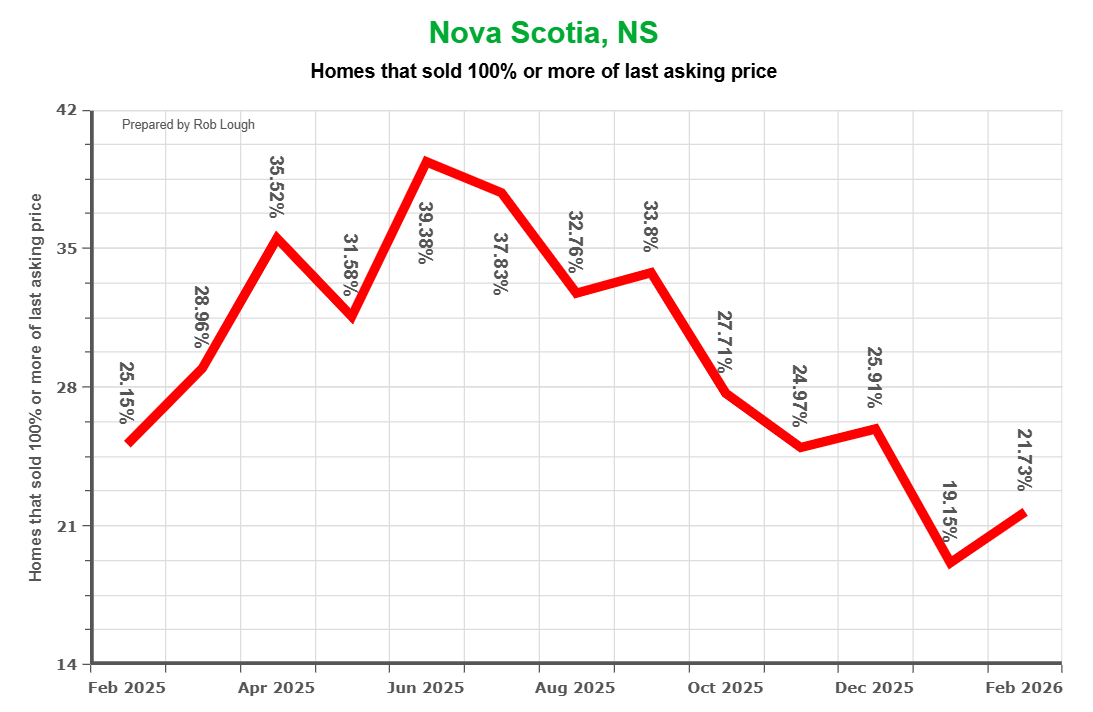
Another piece of data worth paying attention to is the trend in how many Nova Scotia homes are selling at 100% or more of their last asking price.
In mid-2025, nearly 40% of all homes in Nova Scotia were selling at or above asking price. As of early 2026, that number has dropped to approximately 21.73%.
How to Price Your Home to Sell in Nova Scotia: Why the First Week on Market Matters Most
This shift reflects a market that is becoming more balanced. Buyers have more options, more time, and more room to negotiate. For sellers, this makes accurate pricing even more critical. You can’t rely on a rising tide to bail out an ambitious asking price—you need to be sharp from the start. For more context on where the market stands right now, see my Halifax-Dartmouth Real Estate Market Stats – February 2026.
How to Price Your Home Right from Day One
So what does smart pricing actually look like in practice? Here are a few strategies that work in today’s market:
Work with a local REALTOR® who knows the data.A Comparative Market Analysis (CMA) based on recent sales in your neighbourhood is the foundation of a strong pricing strategy. National averages and online estimates don’t account for what’s happening on your street. For a deeper look at how CMAs differ from bank appraisals, read my guide on Bank Appraisals vs. Real Estate CMAs in Nova Scotia.
Price at or slightly below market value. It may feel counterintuitive, but pricing competitively—especially in the first week—often generates more interest, more showings, and in many cases, multiple offers that push the final sale price above where you started. The data backs this up: in Halifax-Dartmouth, homes that sold in week one averaged above asking.
Don’t let emotion drive the number. What you paid for the home, what you spent on renovations, or what you “need” to net from the sale doesn’t change what buyers are willing to pay. The market sets the price—not your mortgage balance.
Get a pre-listing home inspection. Surprises during the buyer’s inspection are one of the top deal killers. A pre-listing inspection helps you identify and address issues before they become negotiation points. If you’re curious about what inspectors look for, I wrote a guide based on my background as a former Home Inspector: What to Expect from a Home Inspection.
What This Means for Buyers
Buyer Takeaway:If you’re looking to purchase, the data tells you that patience can pay off—literally. Homes that have been sitting on the market for several weeks are far more negotiable than fresh listings. That said, if a well-priced home comes up in your target area, don’t wait. Week-one sales often attract competing offers, and hesitation could cost you. The key is being pre-approved for a mortgage so you can move quickly and confidently when the right home appears. Learn more: Why Getting Pre-Approved Is the Smartest First Step When Buying a Home in Halifax.
What This Means for Sellers
Seller Takeaway:Your best chance of maximizing your sale price is in the first week. Every week after that, the data shows your leverage decreasing. Work with your agent to develop a pricing strategy based on real, local comparables—not hope. If you’d like a no-obligation market evaluation of your home, reach out to me here and let’s talk about what your home could realistically sell for in today’s market.
The Bottom Line
Whether you’re selling in Halifax, Dartmouth, or anywhere else in Nova Scotia, the message from the data is consistent: pricing accuracy on day one is the single biggest factor in how much money you walk away with.
The homes that sell the fastest also sell for the most. The longer a property sits, the more buyers sense an opportunity to negotiate. In a market where fewer homes are fetching full asking price, there’s simply no room for guesswork.
If you’re considering selling and want a data-driven pricing strategy tailored to your specific property and neighbourhood, I’d be happy to help. With over 24 years of experience in Nova Scotia real estate—including a background as a Home Inspector—I bring a level of insight that goes beyond the surface numbers.
Related Resources
-
- Halifax-Dartmouth Real Estate Market Stats – February 2026
- Halifax-Dartmouth Real Estate Market Stats – January 2026
- Why Getting Pre-Approved Is the Smartest First Step When Buying a Home in Halifax
- Bank Appraisal vs. Real Estate CMA in Nova Scotia
- Closing Costs When Buying in Nova Scotia
- Contact Rob Lough
Rob Lough is the Broker/Owner of Century 21 Optimum Realty, serving the Halifax Regional Municipality, East Hants, and Truro markets. With over 25 years of real estate experience and a background as a Home Inspector, Rob provides data-driven advice to help Nova Scotia homeowners make informed decisions about buying and selling property.