
Halifax Rent Growth Is Cooling in 2026 But the Affordable End Remains Squeezed
By Rob Lough, Broker/Owner | Century 21 Optimum Realty | Halifax-Dartmouth, Nova Scotia Published: March 2026
The Headline Numbers Tell a Cautiously Encouraging Story
If you've been renting in Halifax and watching your lease renewal letters with dread, there's a real signal worth paying attention to in the latest financial results from two of the city's biggest landlords. Killam Apartment REIT and CAPREIT together control just over 9,000 rental units in Halifax, making their annual numbers one of the most reliable market-level data points available for the local rental landscape.
Both reported slower rent growth in 2025 compared to 2024. That's meaningful. Whether it translates into genuine affordability relief depends on which segment of the market you're in — and the picture there is more complicated.
What Killam and CAPREIT Actually Reported
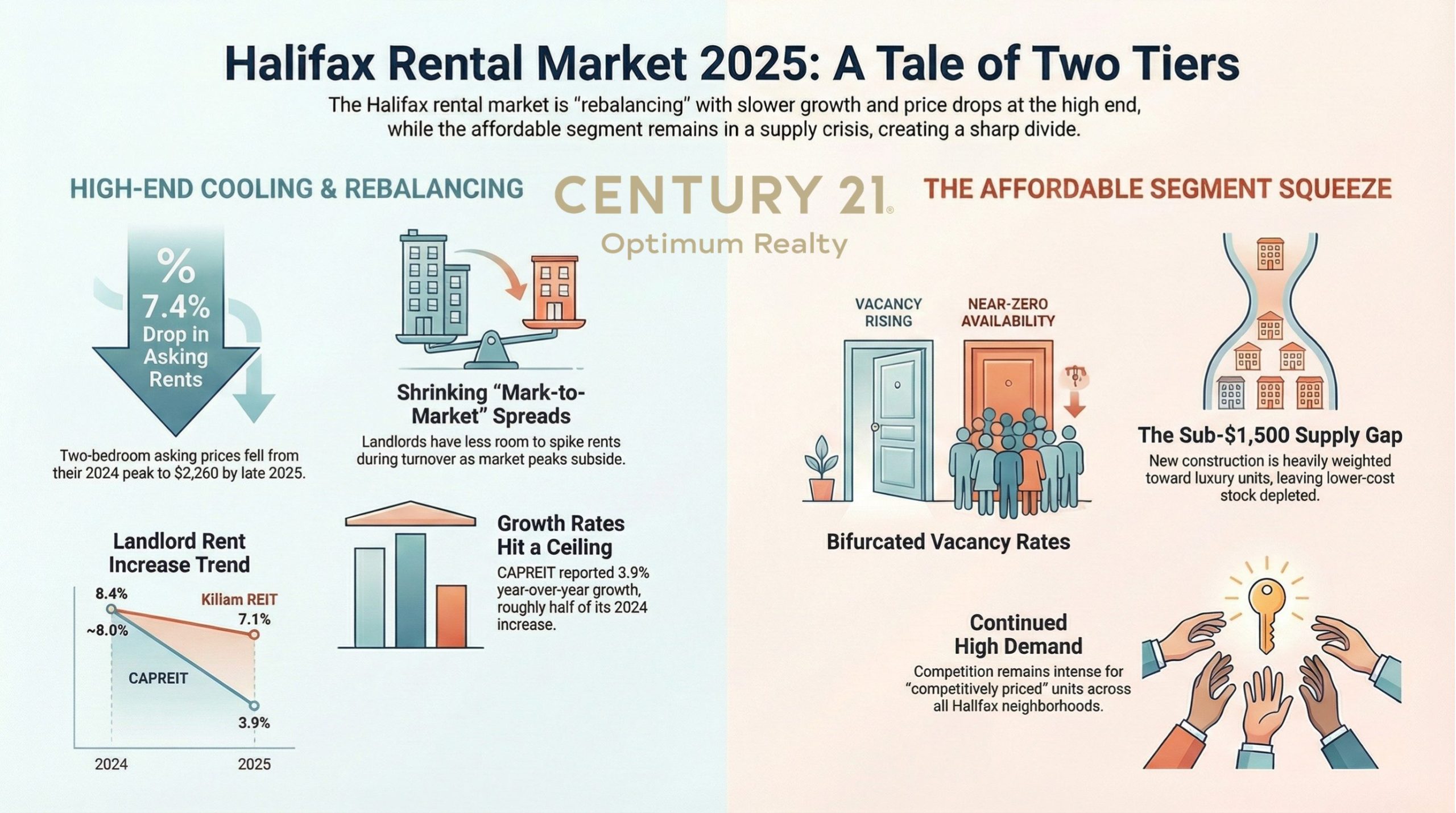
CAPREIT's average Halifax rent at the end of 2025 came in at approximately $1,713 per month, reflecting a 3.9 percent year-over-year increase. That sounds like a lot in absolute terms, but it's roughly half the increase the company posted in 2024. The direction of travel has clearly shifted.
Killam's numbers tell a similar story. The REIT reported a 7.1 percent average rent increase in Halifax for 2025, down from 8.4 percent in 2024. More significantly, Killam noted this was the first time between 2018 and 2025 that its annual average rent increase in Halifax was lower than the prior year. That's a streak ending and a streak that had defined renting in this city for nearly a decade.
A real estate consultant quoted in CBC's reporting on the Q4 results described these results as another sign that Halifax's rental market is "rebalancing" after a prolonged period of runaway increases. That word, rebalancing, is doing a lot of work, and it's worth unpacking what it does and doesn't mean.
Asking Rents at the Top End Have Pulled Back
The cooling isn't limited to renewal increases on existing tenants. Statistics Canada data cited in the CBC story shows that asking rents for two-bedroom apartments in Halifax sat at approximately $2,260 at the end of 2025, down 7.4 percent from the peak reached in the second quarter of 2024.
That's a notable correction at the higher end of the market. It aligns with what we've been tracking in purpose-built rental construction trends across Nova Scotia, where a wave of new completions in Halifax has given tenants searching for newer, higher-end units slightly more choice and some negotiating room that simply didn't exist a year ago.
What Killam's Mark-to-Market Data Signals for Future Increases
One of the more telling data points from Killam's Q4 2025 earnings call was a metric the company calls its "mark-to-market spread", the gap between current rents being paid by tenants and estimated market rents on vacant units. This spread tells investors how much headroom a landlord has to push rents higher when a unit turns over.
That spread shrank in Halifax in 2025. Killam's finance leadership linked the narrowing gap to a combination of moderated asking rents on vacant units and the increases already locked in over recent quarters. In plain language: there's less room to spike rents dramatically on turnover than there was even a year ago, because market rents on new listings have themselves come off the peak. The era of aggressive double-digit turnover increases may be fading, at least for the moment.
On the financial performance side, Killam still reported solid fundamentals, 6.1 percent same-property net operating income growth and a 4.2 percent rise in funds from operations per unit, which underlines that income is still growing even as rent growth moderates. The company's net income figure fell sharply year-over-year, but that drop reflects large one-time deferred tax recoveries and property fair value gains in 2024 that simply didn't repeat in 2025, not an operational deterioration.
The Part of the Market Where Nothing Has Gotten Easier
Here's the part of this story that needs equal billing: the softening at the top has not filtered down to affordable rental stock.
Experts quoted in the CBC piece are clear that vacancy in the lower-cost segment remains very low. Households looking for cheaper units continue to face intense competition and limited choice. CEO Philip Fraser noted on Killam's earnings call that demand for competitively priced units is the strongest pressure point across the company's national portfolio, not just Halifax. The market has bifurcated sharply between newer, pricier stock (where some relief is appearing) and older, more affordable stock (where it isn't).
This dynamic tracks directly with what I covered in the February 2026 Halifax-Dartmouth market stats affordability remains the defining constraint for a large segment of would-be buyers and renters alike, regardless of what's happening at the upper end of the market.
What This Means If You're Currently Renting in Halifax
For renters at the mid-to-higher end of the market: This data supports a more assertive approach to renewal negotiations than was realistic in 2022 or 2023. Vacancy is no longer near zero for newer purpose-built units. Landlords know it. If your current rent is at or above $1,700–$2,000 per month, you have more comparative alternatives now than you did at the peak, and that gives you some leverage.
For renters seeking affordable units under $1,500: The data provides less comfort here. Vacancy in the lower-cost segment remains tight, and the new supply pipeline has been overwhelmingly weighted toward higher price points. If you're in an affordable unit, protecting that tenancy matters. If you're searching for one, your options remain limited.
The Ownership Side of This Equation
The rental moderation story also has direct implications for the ownership market. For the past several years, high rents and limited ownership inventory created a feedback loop — renters couldn't save fast enough to buy because too much of their income was going to rent. As rent growth cools and some of that pressure eases at the margins, it becomes marginally more realistic for renters to redirect money toward a down payment.
Programs stacking on top of that shift Nova Scotia's 2% down payment pilot and the recently enacted Bill C-4 GST rebate for first-time buyers of new construction, are designed to help close that remaining gap. They won't solve affordability on their own, but they represent real dollars that stack.
For anyone currently renting who is starting to model whether owning pencils out, my Spring 2026 Halifax market overview walks through the current ownership landscape, including how the Bank of Canada rate environment affects what you can qualify for and what you can afford to carry.
The Bigger Picture: A Market in Transition, Not a Market Fixed
The Killam and CAPREIT results are a genuine positive signal after years of relentless rent escalation in Halifax. Rent growth is moderating. Asking rents at the top have pulled back meaningfully from their 2024 peak. The mark-to-market spread is narrowing, which limits how aggressively landlords can push rents on turnover going forward.
But "rebalancing" is not the same as "resolved." The affordable rental segment remains under pressure. New supply has helped primarily at the higher end. And the broader Halifax housing starts and construction boom, while substantial, is still weighted toward rental apartment product rather than the ownership-oriented ground-oriented housing that first-time buyers need.
What we're seeing is a market shifting from emergency mode toward something closer to functional, but for lower-income renters, the emergency isn't over yet.
Related Resources
- Halifax-Dartmouth Real Estate Market Stats — February 2026
- Halifax Condo and Apartment Market Report — February 2026
- Purpose-Built Rentals Are Booming in Canada — What It Means for Halifax
- Spring 2026 Halifax Real Estate Guide
- Killam Q1 2026 recap
- CBC: Killam and CAPREIT Q4 2025 Financial Results
Rob Lough is Broker/Owner at Century 21 Optimum Realty, serving Halifax Regional Municipality, East Hants, and the Truro/District 104 market. With 25 years of Nova Scotia real estate experience, including 5 years as a licensed Home Inspector, Rob brings a depth of practical market knowledge to buyers, sellers, and investors across the region. Connect with Rob at roblough.c21.ca.
CENTURY 21 Optimum Realty
INFO & SERVICES
CENTURY 21 Optimum Realty
24 Logiealmond Close, Unit 24, Dartmouth, NS B3B0C8
(902) 444-1333
INFO & SERVICES

Independently Owned and Operated. ®/™ trademarks owned by Century 21 Real Estate LLC used under license or authorized sub-license. © 2020 Century 21 Canada Limited Partnership © 2020 Century 21 Canada Limited Partnership
The trademarks MLS®, Multiple Listing Service® and the associated logos identify professional services rendered by REALTOR® members of CREA to effect the purchase, sale and lease of real estate as part of a cooperative selling system. The trademarks REALTOR ® , REALTORS ® and the REALTOR ® logo are controlled by The Canadian Real Estate Association (CREA) and identify real estate professionals who are members of CREA. Used under license. This listing content provided by REALTOR.ca has been licensed by REALTOR® members of The Canadian Real Estate Association. Not intended to solicit properties currently listed for sale or buyers under contract.
Century 21 Canada Limited Partnership currently has franchise opportunities available in select markets across Canada. The intent of this communication is for informational purposes only and is not intended to be a solicitation to anyone under contract with another real estate brokerage operation. This e-mail message contains confidential information intended only for the use of the individual or entity named above. Any unauthorized use or disclosure is strictly prohibited. If you have received this communication in error please immediately delete the e-mail and either notify the sender at the above e-mail address or by telephone.
© 2026 MoxiWorks
